Building a Scalable Library System with MVC and Modular Design
## 1. Problem Statement
## **Chaos at "Maplewood Public Library"**
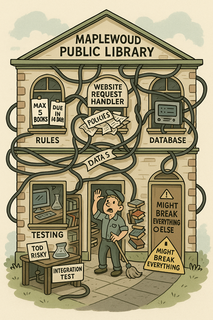
Maplewood Public Library’s software system is in disarray:
- Rules like "members can’t borrow more than 5 books" are buried in code that handles website requests. When policies change, updates risk breaking other parts of the system.
- The team wants to add new features (e.g., online reservations, late fines) but struggles because data access and business logic are tangled together.
- Testing is nearly impossible-every small change requires rewriting large parts of the code.
 **The challenge:**
How do you redesign the system so that:
- Rules and policies are clearly separated and easy to update?
- Data storage details don’t interfere with how books are managed or loans are processed?
- New features can be added without fear of breaking existing functionality?
## 2. Learning Objectives
By the end of this lesson, you’ll be able to:
- Structure code using **MVC (Model-View-Controller)** to separate rules, data, and user interactions.
- Use the **Repository Pattern** to isolate data storage details from business logic.
- Apply **Dependency Injection** to create modular, testable components.
## 3. Concept Introduction with Analogy
## **Analogy: The Library’s Organizational Chart**
Imagine the library has three teams:
1. **Front Desk (Controller):** Handles member requests (checkouts, returns).
2. **Policy Team (Service):** Manages rules (loan limits, fines).
3. **Archives Team (Repository):** Stores and retrieves books from the shelves.
Each team works independently:
- The front desk doesn’t care _how_ books are stored-it just asks the archives team to fetch them.
- The policy team enforces rules without knowing _where_ books are kept.
- If the archives team reorganizes the shelves (changes storage systems), the other teams keep working as usual.
This separation prevents chaos and lets the library adapt to changes smoothly.
**A. MVC Pattern: Separating Concerns**
| Layer | Responsibility | Example in Library |
|--------------|---------------------------------------|-------------------------------------|
| Model | Data structure and validation | Book, Member classes |
| View | Presentation (JSON, HTML) | API responses |
| Controller | Handles user requests/responses | BookController routes |
| Service | Business logic (e.g., loan rules) | Calculating fines, reservations |
| Repository | Data storage/retrieval | Fetching books from storage |
**B. Repository Pattern: Isolate Storage Details**
- **Repository Interface:** Defines _what_ operations are available (e.g., `findAllBooks()`, `saveBook()`).
- **Implementation:** Handles _how_ data is stored (e.g., in-memory, files, databases).
**Why?**
- Change storage systems without rewriting business logic.
- Test services with fake repositories (no real storage needed).
**C. Dependency Injection: Building Modular Systems**
- **Dependency Injection (DI):** Provide components with their dependencies (e.g., services, repositories) instead of letting them create their own.
- **Benefits:**
- Swap components easily (e.g., switch storage systems for testing).
- Avoid tight coupling between layers.
## 5. Step-by-Step Data Modeling & Code Walkthrough
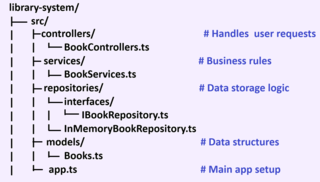
## **A. Project Structure**
**The challenge:**
How do you redesign the system so that:
- Rules and policies are clearly separated and easy to update?
- Data storage details don’t interfere with how books are managed or loans are processed?
- New features can be added without fear of breaking existing functionality?
## 2. Learning Objectives
By the end of this lesson, you’ll be able to:
- Structure code using **MVC (Model-View-Controller)** to separate rules, data, and user interactions.
- Use the **Repository Pattern** to isolate data storage details from business logic.
- Apply **Dependency Injection** to create modular, testable components.
## 3. Concept Introduction with Analogy
## **Analogy: The Library’s Organizational Chart**
Imagine the library has three teams:
1. **Front Desk (Controller):** Handles member requests (checkouts, returns).
2. **Policy Team (Service):** Manages rules (loan limits, fines).
3. **Archives Team (Repository):** Stores and retrieves books from the shelves.
Each team works independently:
- The front desk doesn’t care _how_ books are stored-it just asks the archives team to fetch them.
- The policy team enforces rules without knowing _where_ books are kept.
- If the archives team reorganizes the shelves (changes storage systems), the other teams keep working as usual.
This separation prevents chaos and lets the library adapt to changes smoothly.
**A. MVC Pattern: Separating Concerns**
| Layer | Responsibility | Example in Library |
|--------------|---------------------------------------|-------------------------------------|
| Model | Data structure and validation | Book, Member classes |
| View | Presentation (JSON, HTML) | API responses |
| Controller | Handles user requests/responses | BookController routes |
| Service | Business logic (e.g., loan rules) | Calculating fines, reservations |
| Repository | Data storage/retrieval | Fetching books from storage |
**B. Repository Pattern: Isolate Storage Details**
- **Repository Interface:** Defines _what_ operations are available (e.g., `findAllBooks()`, `saveBook()`).
- **Implementation:** Handles _how_ data is stored (e.g., in-memory, files, databases).
**Why?**
- Change storage systems without rewriting business logic.
- Test services with fake repositories (no real storage needed).
**C. Dependency Injection: Building Modular Systems**
- **Dependency Injection (DI):** Provide components with their dependencies (e.g., services, repositories) instead of letting them create their own.
- **Benefits:**
- Swap components easily (e.g., switch storage systems for testing).
- Avoid tight coupling between layers.
## 5. Step-by-Step Data Modeling & Code Walkthrough
## **A. Project Structure**
 ## **B. Model: Define the Book Structure**
```typescript
// src/models/Book.ts
export interface Book {
id: string;
title: string;
author: string;
isBorrowed: boolean;
}
```
## **C. Repository: Separate Storage Logic**
```typescript
// src/repositories/interfaces/IBookRepository.ts
export interface IBookRepository {
findAll(): Promise;
findById(id: string): Promise;
save(book: Book): Promise;
}
// src/repositories/InMemoryBookRepository.ts
import { IBookRepository } from './interfaces/IBookRepository';
import { Book } from '../models/Book';
export class InMemoryBookRepository implements IBookRepository {
private books: Book[] = [];
async findAll(): Promise {
return this.books;
}
async findById(id: string): Promise {
return this.books.find(book => book.id === id) || null;
}
async save(book: Book): Promise {
this.books.push(book);
}
}
```
## **D. Service: Enforce Business Rules**
```typescript
// src/services/BookService.ts
import { IBookRepository } from '../repositories/interfaces/IBookRepository';
import { Book } from '../models/Book';
export class BookService {
constructor(private bookRepository: IBookRepository) {}
async borrowBook(bookId: string): Promise {
const book = await this.bookRepository.findById(bookId);
if (!book) throw new Error('Book not found');
if (book.isBorrowed) throw new Error('Book already borrowed');
const updatedBook = { ...book, isBorrowed: true };
await this.bookRepository.save(updatedBook);
return updatedBook;
}
}
```
## **E. Controller: Handle User Requests**
```typescript
// src/controllers/BookController.ts
import { Request, Response } from 'express';
import { BookService } from '../services/BookService';
export class BookController {
constructor(private bookService: BookService) {}
async borrowBook(req: Request, res: Response): Promise {
try {
const book = await this.bookService.borrowBook(req.params.id);
res.json(book);
} catch (error) {
res.status(400).json({ error: error.message });
}
}
}
```
## **F. Dependency Injection Setup**
```typescript
// src/app.ts
import express from 'express';
import { BookController } from './controllers/BookController';
import { BookService } from './services/BookService';
import { InMemoryBookRepository } from './repositories/InMemoryBookRepository';
const app = express();
app.use(express.json());
// Initialize components
const bookRepository = new InMemoryBookRepository();
const bookService = new BookService(bookRepository);
const bookController = new BookController(bookService);
// Routes
app.post('/books/:id/borrow', (req, res) => bookController.borrowBook(req, res));
const port = 3000;
app.listen(port, () => {
console.log(`Library system running on port ${port}`);
});
```
## 6. Challenge
**Your Turn!**
- Add a `returnBook` method to `BookService` and `BookController`.
- Ensure the repository updates the book’s status when returned.
## 7. Common Pitfalls & Best Practices
| **Pitfall** | **Best Practice** |
|------------------------------------------|----------------------------------------------------------|
| Mixing data access in business logic | Always use repositories for storage access |
| Hardcoding storage details | Depend on interfaces, not implementations |
| Not testing with mocks | Use fake repositories for unit tests |
## 8. Quick Recap & Key Takeaways
- **Separate layers** (controllers, services, repositories) for clarity.
- **Repository Pattern** hides storage details from business rules.
- **Dependency Injection** makes components reusable and testable.
## 9 Optional: Programmer’s Workflow Checklist (MVC Pattern)
- **Identify the main resources** in your application (e.g., Book, User, Event).
- **Define Models** for each resource (data structure, validation rules).
- **Create Controllers** for each resource to handle user/API requests and responses.
- **Write Services** to contain business logic (rules, calculations, policies).
- **Keep Controllers thin**-they should only coordinate input/output and call services.
- **Never access data storage directly from controllers**-always go through services.
- **If using repositories:** Only services should interact with repositories for data access.
- **Organize code into folders:** `/models`, `/controllers`, `/services` (and `/repositories` if needed).
- **Document the responsibility of each layer** so team members know where to add new logic.
- **Test each layer independently** (e.g., unit test services without controllers).
- **Review regularly:** Refactor if business logic creeps into controllers or data access leaks into services.
## 10. Coming up next
Learn to use automated dependency injection tools (like `tsyringe`) to manage complex systems effortlessly!
## **B. Model: Define the Book Structure**
```typescript
// src/models/Book.ts
export interface Book {
id: string;
title: string;
author: string;
isBorrowed: boolean;
}
```
## **C. Repository: Separate Storage Logic**
```typescript
// src/repositories/interfaces/IBookRepository.ts
export interface IBookRepository {
findAll(): Promise;
findById(id: string): Promise;
save(book: Book): Promise;
}
// src/repositories/InMemoryBookRepository.ts
import { IBookRepository } from './interfaces/IBookRepository';
import { Book } from '../models/Book';
export class InMemoryBookRepository implements IBookRepository {
private books: Book[] = [];
async findAll(): Promise {
return this.books;
}
async findById(id: string): Promise {
return this.books.find(book => book.id === id) || null;
}
async save(book: Book): Promise {
this.books.push(book);
}
}
```
## **D. Service: Enforce Business Rules**
```typescript
// src/services/BookService.ts
import { IBookRepository } from '../repositories/interfaces/IBookRepository';
import { Book } from '../models/Book';
export class BookService {
constructor(private bookRepository: IBookRepository) {}
async borrowBook(bookId: string): Promise {
const book = await this.bookRepository.findById(bookId);
if (!book) throw new Error('Book not found');
if (book.isBorrowed) throw new Error('Book already borrowed');
const updatedBook = { ...book, isBorrowed: true };
await this.bookRepository.save(updatedBook);
return updatedBook;
}
}
```
## **E. Controller: Handle User Requests**
```typescript
// src/controllers/BookController.ts
import { Request, Response } from 'express';
import { BookService } from '../services/BookService';
export class BookController {
constructor(private bookService: BookService) {}
async borrowBook(req: Request, res: Response): Promise {
try {
const book = await this.bookService.borrowBook(req.params.id);
res.json(book);
} catch (error) {
res.status(400).json({ error: error.message });
}
}
}
```
## **F. Dependency Injection Setup**
```typescript
// src/app.ts
import express from 'express';
import { BookController } from './controllers/BookController';
import { BookService } from './services/BookService';
import { InMemoryBookRepository } from './repositories/InMemoryBookRepository';
const app = express();
app.use(express.json());
// Initialize components
const bookRepository = new InMemoryBookRepository();
const bookService = new BookService(bookRepository);
const bookController = new BookController(bookService);
// Routes
app.post('/books/:id/borrow', (req, res) => bookController.borrowBook(req, res));
const port = 3000;
app.listen(port, () => {
console.log(`Library system running on port ${port}`);
});
```
## 6. Challenge
**Your Turn!**
- Add a `returnBook` method to `BookService` and `BookController`.
- Ensure the repository updates the book’s status when returned.
## 7. Common Pitfalls & Best Practices
| **Pitfall** | **Best Practice** |
|------------------------------------------|----------------------------------------------------------|
| Mixing data access in business logic | Always use repositories for storage access |
| Hardcoding storage details | Depend on interfaces, not implementations |
| Not testing with mocks | Use fake repositories for unit tests |
## 8. Quick Recap & Key Takeaways
- **Separate layers** (controllers, services, repositories) for clarity.
- **Repository Pattern** hides storage details from business rules.
- **Dependency Injection** makes components reusable and testable.
## 9 Optional: Programmer’s Workflow Checklist (MVC Pattern)
- **Identify the main resources** in your application (e.g., Book, User, Event).
- **Define Models** for each resource (data structure, validation rules).
- **Create Controllers** for each resource to handle user/API requests and responses.
- **Write Services** to contain business logic (rules, calculations, policies).
- **Keep Controllers thin**-they should only coordinate input/output and call services.
- **Never access data storage directly from controllers**-always go through services.
- **If using repositories:** Only services should interact with repositories for data access.
- **Organize code into folders:** `/models`, `/controllers`, `/services` (and `/repositories` if needed).
- **Document the responsibility of each layer** so team members know where to add new logic.
- **Test each layer independently** (e.g., unit test services without controllers).
- **Review regularly:** Refactor if business logic creeps into controllers or data access leaks into services.
## 10. Coming up next
Learn to use automated dependency injection tools (like `tsyringe`) to manage complex systems effortlessly!